
Prime Minister Narendra Modi and Israeli PM Benjamin Netanyahu held a telephone conversation to discuss recent developments in West Asia, emphasising the urgent need for peace and stability. They also reaffirmed their commitment to strengthening the India-Israel Special Strategic Partnership.

Navi Pillay, a South African jurist of Indian origin, has been awarded the 2026 Nobel Peace Prize for her efforts to promote peace and international law. The announcement came as she was in Nuremberg, a symbolic location given her career's focus on international justice. Pillay dedicated the prize to survivors and those working for justice, warning against political attacks on international law and institutions like the ICC. Her extensive career includes roles in the International Criminal Tribunal for Rwanda, the International Criminal Court, and as UN High Commissioner for Human Rights.
South African jurist Navanethem 'Navi' Pillay, of Indian origin, has been awarded the 2026 Nobel Peace Prize for her lifelong dedication to advancing human rights, peace, and international law, including her significant contributions to shaping international law on genocide and sexual violence.

Donald Trump asked countries involved in the peace talks with Iran to sign on to the Abraham Accords, which deal with establishing diplomatic, economic and security ties between Israel and Arab nations.

Government officials are reportedly apprehensive that the 30,000 to 40,000 US troops currently deployed within the region could serve as the primary target of the Islamic Republic in the event of an all-out war.
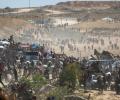
India has joined over 100 countries and global organizations in condemning Israel's "unilateral" decisions and measures aimed at expanding its "unlawful presence" in the West Bank.

Sagiv Steinberg, CEO of the Jerusalem Center for Security and Foreign Affairs (JCFA), described the recent US-Iran peace agreement as a temporary 60-day ceasefire, not a genuine peace deal, suggesting it's timed for the upcoming US midterm elections.

The BRICS foreign ministers' meeting in New Delhi concluded without a joint statement due to disagreements over the West Asia conflict, with Iran blaming the UAE for the lack of consensus. India, as the host, issued a chair's statement highlighting the differing views.

Iran launched retaliatory military strikes targeting Israel and American military bases across the region, including in Qatar, the United Arab Emirates, Kuwait, Bahrain and Jordan.

The IRGC also warned residents to evacuate areas near military bases, security centres and government facilities.

At least three Israelis were killed and six others injured when Palestinian gunmen opened fire at a bus stop in Jerusalem, breaking an uneasy peace in the city since the outbreak of the current round of violence in the region.

'Jews are very much safe in Iran. They are our brothers. There is a difference between a Jew and a Zionist.' A conversation around a tea table in Mumbai serves as an eye-opener for Syed Firdaus Ashraf.

He ordered to start the process of moving the United States embassy from Tel Aviv to the holy city.

A United Nations commission of inquiry has found that Israel has committed genocide against Palestinians in Gaza.

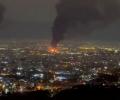
Dimona and Ahad came under intense Iranian missile fire over the weekend as the conflict entered a far more volatile phase. These photographs capture the aftermath of the strikes -- thick smoke rising over the cities, emergency teams rushing to the scenes and residents caught in the chaos that followed.
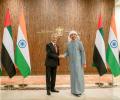
Frankly, was it really necessary in the middle of a fratricidal war for External Affairs Minister S Jaishankar to travel to Abu Dhabi for a one-on-one with the sheikh on April 12?Or, for National Security Advisor Ajit Doval to follow up on April 26? Or, for PM Narendra Modi to follow through today? There are no easy answers, notes Ambassador M K Bhadrakumar.
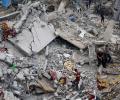
The resolution, introduced by France, was adopted with an overwhelming 142 nations voting in favour, 10 against and 12 abstentions. Those voting against included Argentina, Hungary, Israel and the US.

The deployment could include infantry and armoured units, in addition to the 82nd Airborne Division, which is already stationed in the region.

IDF chief stressed the urgent need for legislative measures, including a conscription law, a reserve duty law, and an extension of mandatory military service.
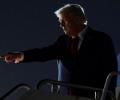
Calling the Gaza ceasefire 'the historic dawn of a new Middle East', United States President Donald Trump on Monday said the forces of 'chaos, terror, and ruin' have been defeated, and the 'long and painful nightmare' is finally over not only for Israelis but also for Palestinians.

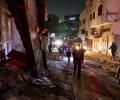
An Iranian missile strike targeted the town of Beit Shemesh, located west of Jerusalem, resulting in significant casualties and structural devastation, as reported by Al Jazeera. The strike caused extensive damage earlier Sunday to several buildings, with one structure completely collapsing under the impact.
India voted in favor of a United Nations General Assembly resolution that called for the withdrawal of Israel from the Palestinian territory occupied since 1967, including East Jerusalem, and reiterated the call for achieving a comprehensive, just and lasting peace in West Asia. The resolution, tabled by Senegal, was adopted with 157 nations voting in favor, while eight nations voted against it and seven abstained.

'Neither do the Israelis. The two attacking parties have very little economic interest in Hormuz.'

'In such a scenario, Iran could proclaim itself victor, rebuild, re-enforce its diminished regional proxies to further destabilise neighbouring nations and take control of the Persian Gulf and Strait of Hormuz.'

India is one of the few nations, and perhaps the only nation, that has good relations with America, Israel and Iran. Knowing that a war in the Gulf would damage our economy, hurt supply of fertilisers and fuel, and cause general chaos, we should have tried to ensure this war did not begin, asserts Aakar Patel.
The Congress party has criticised the Indian government's diplomatic strategy, claiming a 'severe setback' if reports of Pakistan mediating between the US-Israel and Iran are accurate. The party alleges Pakistan's diplomatic engagement has surpassed India's, despite military successes.

'What we have yet to see on either the US or the Iranian side is willingness to compromise on their ultimate demands and the flexibility to reach an agreement to end the war.

Israel initiated military action against Iran shortly after Prime Minister Narendra Modi's visit, capitalising on a fleeting opportunity and years of strategic preparation, according to Israel's ambassador to India.

The intriguing bit is that Trump is likely to attend the talks in Islamabad this weekend -- if he does, it will be the clearest signal yet that the US is ready to exit the war with some sort of win to show, since he cannot afford to go for the talks and return empty-handed, notes Prem Panicker in his must read blog on the Iran War

Israeli authorities stated that after Palestinians threw explosives at the fence separating Israel and Gaza, its officers opened fire, according to Al Jazeera.

If the Iranian regime needs to be punished for promoting quasi-terrorist outfits like Hezbollah and Hamas, then what about Pakistan which has spent decades exporting terror around the world, killing thousands, particularly in Afghanistan and India? asks M R Narayan Swamy.

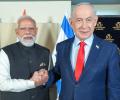
India and Israel have elevated their relationship to a special strategic partnership, focusing on enhanced cooperation in trade, technology, and defense, while also addressing regional peace initiatives.

Prime Minister Narendra Modi addressed the Israeli Parliament, reaffirming India's support for Israel in the face of terrorism and expressing support for the Gaza peace initiative.

US-Israel air attacks intensified on the seventh day of war, striking Tehran and other Iranian cities.

As days turn into weeks and America loses more planes, as the destruction of trillions of dollars worth military assets piles up, and dead bodies of soldiers return in ever greater numbers in coffins, Trump will have to answer some very difficult questions to save his presidency, notes Ambassador M K Bhadrakumar.

Iran is fighting a different war: Older, slower, and in some ways more dangerous. Iran doesn't need to shoot down an F/A-18. It only needs to make the Strait of Hormuz feel dangerous long enough for insurance markets, shipping companies, and oil futures traders to do the rest. Prem Panicker continues his must-read daily blog on the war in the Middle East.
To be sure, Trump is furious, as the trajectory of the war is in a state of Zugzwang, as chess players call it. Trump and Netanyahu stare at two choices -- retreat in humiliation and concede Tehran's demands -- recognition of its rights, reparations, and binding security guarantees -- or perish in a quagmire, points out Ambassador M K Bhadrakumar.

The core issues to be settled -- access to Hormuz, Israel's aggression in Lebanon, the question of Iran's nuclear programme, sanctions relief and compensation -- are thorny enough to require weeks of patient negotiation. The most likely outcome of the opening sessions is that both sides take the measure of each other, establish what is and is not negotiable, and return home without having broken anything. That would count as progress.

The Washington Post Guild, the union for staff members, had appealed to the public to send a message to Bezos: "Enough is enough. Without the staff of The Washington Post, there is no Washington Post."

Israeli officials have turned down the President's request citing security concerns.
